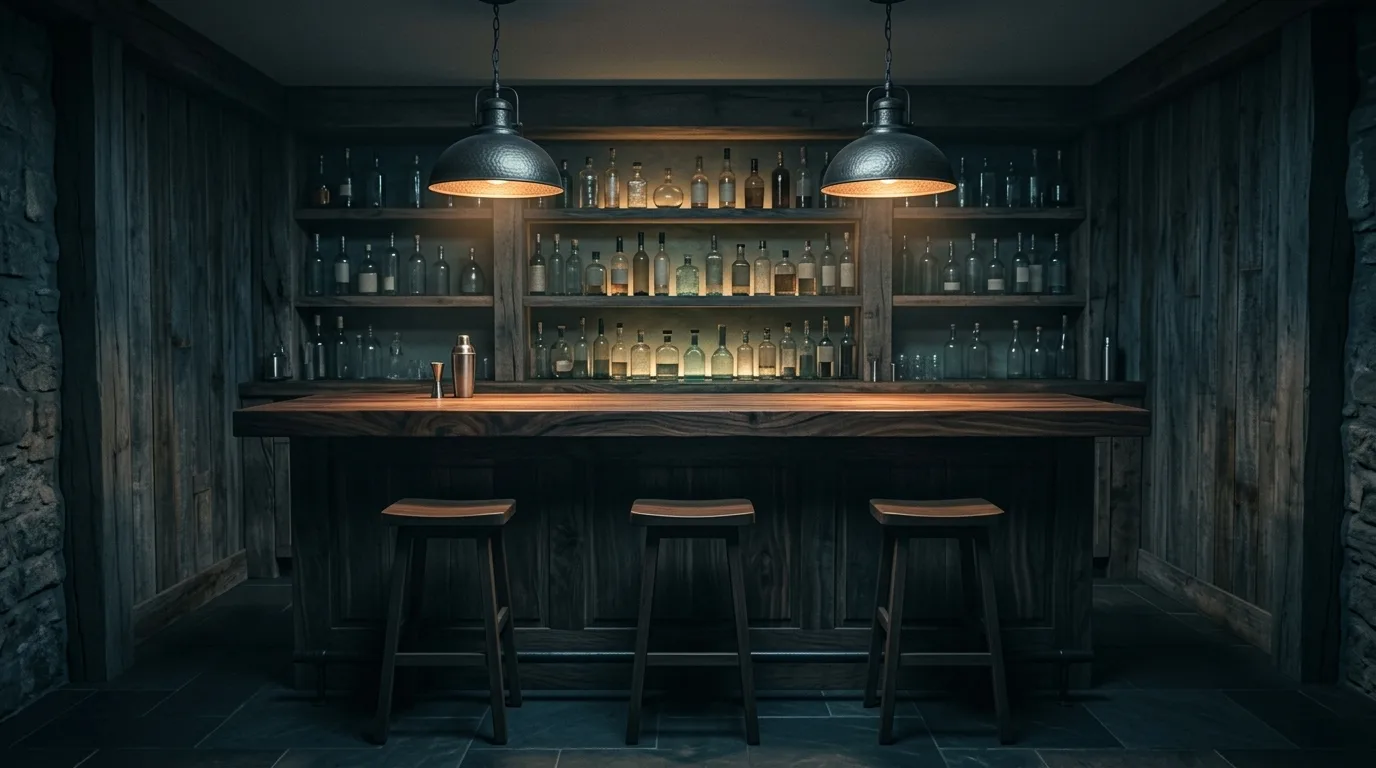
Good bar lighting comes in layers. Task light falls on the work surface so the host can cut a twist and read a jigger, accent light picks out the back bar, and the rest of the room stays dim enough that the bar reads as its warm center. Gray Kangaroo's piece on what makes the perfect bar calls this pools of light, and the practical side comes down to fixture placement, color, and dimming.
Pendants over the bar top
Pendants are the usual task light. A common starting point is to hang the bottom of each fixture about 30 to 36 inches above the bar top, then adjust so seated guests can see each other underneath and standing guests aren't looking straight into a bulb. On a two-level bar, center the pendants over the surface that needs the light, which is usually the work counter.
For spacing, divide the bar into equal sections and hang a pendant at the center of each, keeping the outside fixtures at least 6 inches in from the ends of the top. Two pendants suit a 6-foot bar and three suit 8 to 10 feet, depending on the fixture size. Shaded fixtures that aim light down keep glare out of people's eyes, while clear globes with exposed bulbs look good switched off and glare when they're on unless the lamps are very dim.
Color temperature and color rendering
Keep the light warm. A 2700K lamp is the standard warm white for homes, and 2200K to 2400K lamps and tape give a lower, candlelike glow that suits a bar at night. Cooler light around 4000K looks clinical next to wood and amber spirits. Whatever you choose, match it across the pendants, the shelf lighting, and any recessed lights, because mixed color temperatures show up as patches of different whites.
Color rendering matters at a bar because so much on the counter is judged by color. A color rendering index (CRI) of 90 or higher makes whiskey look amber, keeps citrus and garnishes looking fresh, and keeps skin tones natural. Many inexpensive LED strips and bulbs sit in the low 80s, so check the specification before buying.
Back bar and shelf lighting
LED tape is the usual way to light shelves. Mount it in an aluminum channel with a frosted diffuser along the front underside of each shelf, aimed back toward the wall, and the light washes down over the bottles without visible dots. The channel also draws heat away from the tape, which helps it last. Glass shelves can be lit from the back edge or from below for a stronger glow.
Backlighting does even more for bottles. A panel of frosted acrylic or thin stone with tape behind it lights spirits from behind, so amber and green glass glows. Leave a couple of inches or more between the tape and the panel so the light spreads evenly, and plan a way to reach the tape and driver before the panel goes up.
Drivers, voltage, and dimming
LED tape runs on low-voltage DC from a driver. Tape rated for 12 volts typically runs about 16 feet before the far end dims from voltage drop, and 24-volt tape can run roughly twice that, so 24 volts is the easier choice for a long back bar. Size the driver with headroom, a common rule being to load it to no more than about 80 percent of its rating, and mount it where it can be reached and has air around it.
Dimming is where builds most often go wrong. Tape can be dimmed through a dimmable driver controlled by a matching wall dimmer, often an ELV, TRIAC, or 0-10V type, or with a low-voltage dimmer placed between the driver and the tape. Mismatched parts cause flicker, buzzing, or a dimmer that only works over part of its range, so pick the driver and dimmer together from the manufacturers' compatibility lists and buy LED-rated dimmers for the pendants as well. Where the driver lives and how it's powered are covered in the plumbing and electrical basics.
Switching and scenes
Put the pendants, the shelf lighting, and the room's general lighting on separate controls so each can be set on its own. A typical evening setting has the shelves up, the pendants low, and the room lights off or nearly off. Cleanup is the opposite, with everything bright. Smart dimmers can store both as scenes, though a row of ordinary LED dimmers does the same job with a little more fiddling.
Common lighting mistakes
Recessed cans directly over the stools are the most frequent problem, because they light the tops of heads and cast shadows down faces. A mirrored back bar reflects every exposed bulb in the room, so check sightlines before mounting fixtures across from one. Cool white tape and fixtures without dimmers cause the other common complaint, a bar with a single setting that looks like a workshop at full brightness, and warmer lamps with a dimmer on every circuit fix most of it.