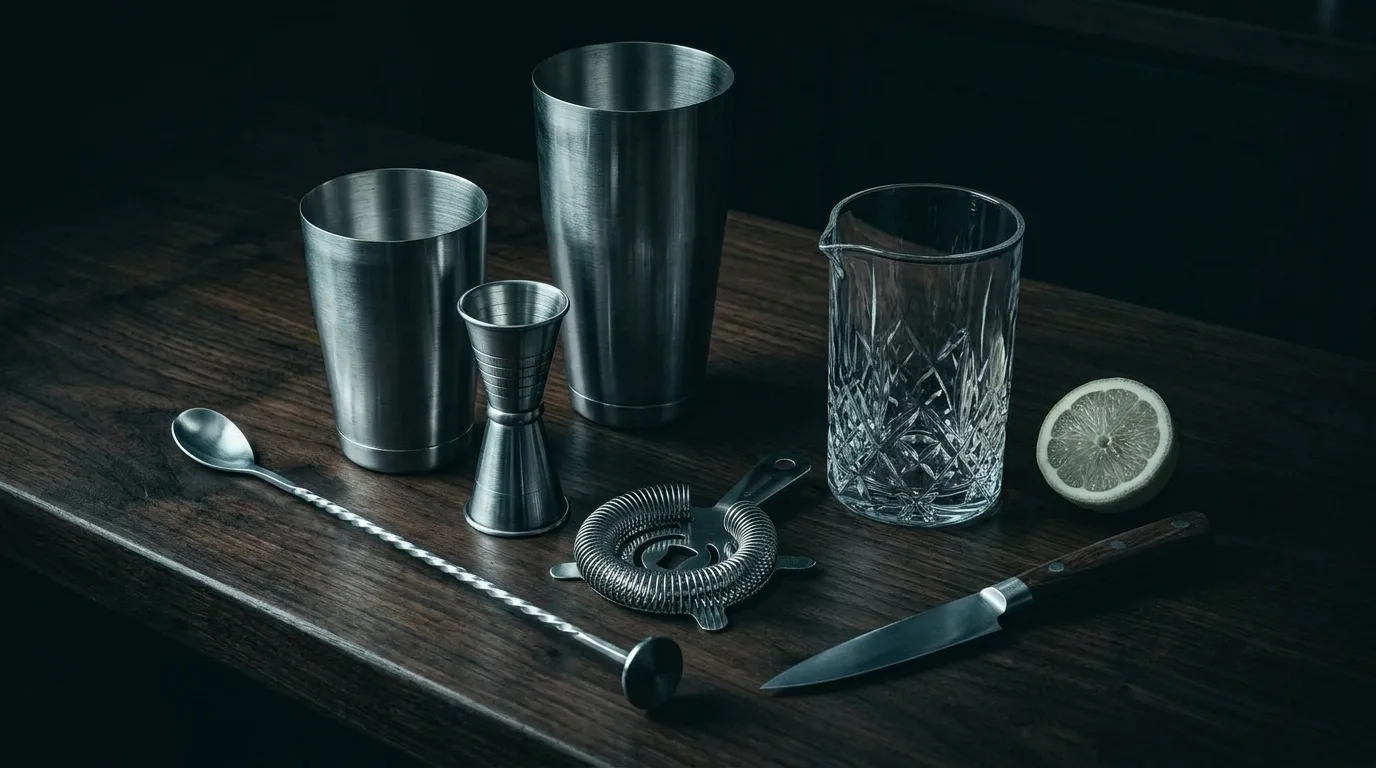
A home bar needs a short list of tools and a few glass shapes, and the list grows slowly as you find drinks you like making. The perfect bar article names seven core tools that fit in a drawer. This guide adds sizes and alternatives for each, along with the glassware Gray Kangaroo suggests buying first.
Shaking and stirring
A two-piece tin-on-tin shaker is what most bartenders use. The usual pair is a large tin of about 28 ounces and a small one of about 18 ounces, and weighted tins seal more easily than unweighted ones. A three-piece cobbler shaker with a built-in strainer is friendlier for beginners, though its cap can stick once the metal gets cold. A Boston shaker, a tin paired with a pint glass, works too and lets you see the drink.
Stirred drinks need a mixing glass and a bar spoon. A heavy mixing glass with a pour spout holds two drinks and ice without tipping, and a sturdy pint glass works until you want something nicer. A bar spoon with a long twisted shaft, around 30 to 40 centimeters, reaches the bottom of the glass and spins smoothly between the fingers.
Measuring
Measure everything, at least at first. A Japanese-style jigger with a 1-ounce cup on one end and a 2-ounce cup on the other, marked inside at a half, three-quarters, and an ounce and a half, covers nearly every recipe. One ounce is about 30 milliliters, so metric jiggers in 30 and 60 milliliters are close enough to swap. Fill to the brim for an accurate pour, and keep a spare, since jiggers tend to vanish.
Straining
A Hawthorne strainer, the flat one with a coiled spring, fits over a shaker tin and holds back ice after shaking. A julep strainer, a perforated bowl, sits inside a mixing glass for stirred drinks. Add a small fine-mesh strainer for double straining shaken drinks into a coupe, which catches citrus pulp and ice chips so the drink stays smooth.
Citrus and garnish
Fresh juice makes a big difference in shaken drinks, so a handheld citrus press earns its place early, and one sized for lemons handles limes as well. A Y-peeler cuts wide twists with little pith, and a sharp paring knife with a small cutting board takes care of wheels and wedges. Juice citrus on the day you use it, and keep it in the refrigerator until then.
Ice tools
An insulated ice bucket with tongs or a scoop keeps ice out of the freezer between drinks and keeps hands off it. Large-cube silicone molds make 2-inch cubes for spirit-forward drinks, and a canvas Lewis bag with a wooden mallet turns cubes into crushed ice for juleps and swizzles. Where the ice comes from in the first place is covered in the ice and refrigeration guide.
Glassware for a first set
Three shapes cover most drinks. A rocks glass, often sold as a double old fashioned at around 10 to 14 ounces, serves stirred drinks over a large cube and spirits neat or on ice. A stemmed glass for drinks served up comes next, either a coupe or the smaller, taller Nick and Nora, usually around 5 to 7 ounces. A highball or Collins glass of 10 to 14 ounces handles anything topped with soda or tonic.
Buy enough of each for the number of people you usually host, plus two or three spares for breakage. Thin glass feels better in the hand and breaks more easily, so wash it by hand, which also spares it the clouding that dishwasher detergent and hot cycles can cause over time. Add wine glasses, beer glasses, and a tulip-shaped whisky glass once the core set is in regular use.
What to skip at first
Boxed bar sets often bundle a poorly fitting shaker, a wobbly jigger, and a handful of tools you'll never use, so buying the core pieces one at a time tends to get you better versions of the ones that matter. Speed pourers help in a busy commercial bar and mostly drip at home. Novelty gadgets, decanters, and a dozen specialty glasses can wait until you know which drinks you make every week, and the back bar shelving in the dimensions guide will tell you how much room there is for them.